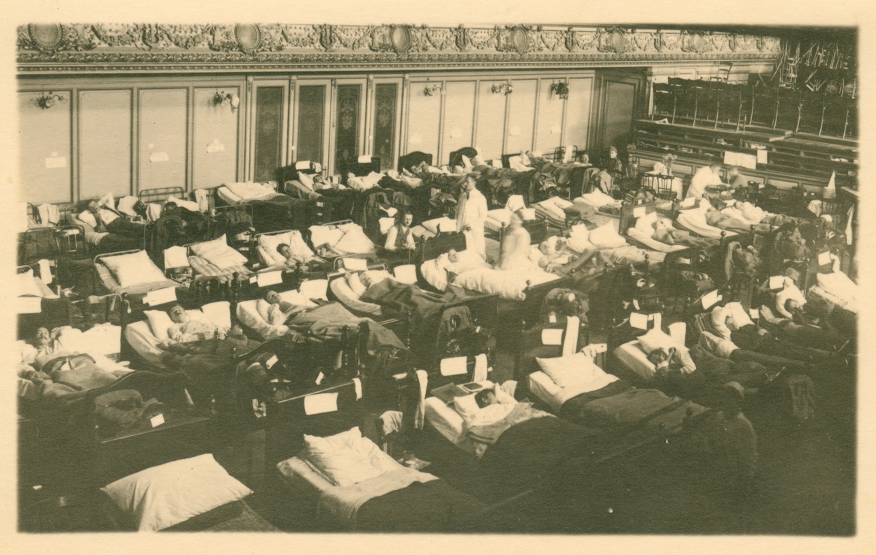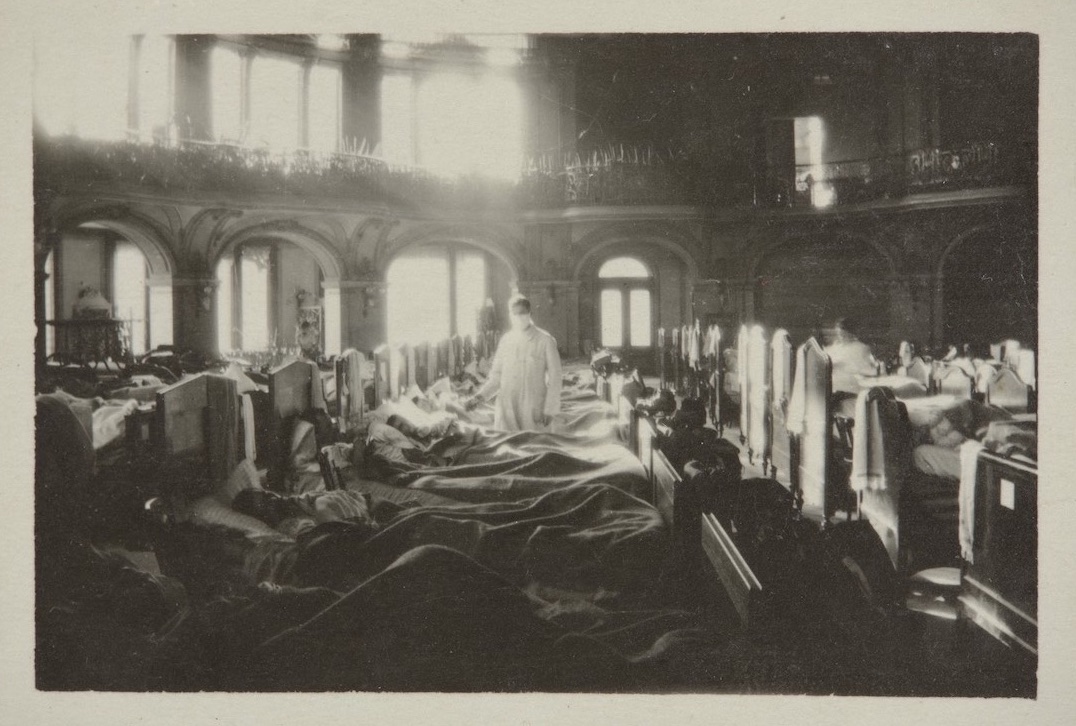
The emergency flu hospital in Zurich Tonhalle, November 1918
Source: Swiss National Museum, inventory number LM-102737.46
Gatherings are banned, hospitals are overcrowded and artists are in need of financial support. The year is not 2020, however, and the pandemic is not called COVID-19. Rather, it is the so-called «Spanish flu», which spread from 1918 to 1920. In the canton of Zurich alone, over 70,000 people fell ill within a week in autumn 1918.
Mid-June 1918: In a factory in Zurich-Aussersihl, almost a third of the workforce is suffering from a feverish illness. A week later, similar reports emerge from a factory in Zurich Albisrieden. Isolated cases of illness are reported in Winterthur, and teachers inform the school authorities about the many sick schoolchildren. The so-called «Spanish flu» has reached Zurich. It quickly becomes apparent that the disease spreads rapidly wherever large numbers of people come together, such as in the military or in a factory in Zurich Oerlikon, where 15 workers fall ill on 4 July 1918. Four days later, 96 new cases are reported in a single day.
Contrary to what its name suggests, the «Spanish flu» did not actually originate in Spain. The reason it was called this has to do with the First World War. As the belligerent countries did not want to show weakness or demoralise their population, they suppressed reports of growing numbers of infections. In Spain, by contrast, which had remained neutral in the war, the press was not censored. Hence, Spain was the first country to report on a strange new disease that even the king had contracted. The government council of Zurich did not generally speak of the «Spanish flu», but rather referred to it as the plague, the epidemic or simply the flu. In July 1919, it wrote of the disease: “It is, however, safe to assume that it was also rampant long before in the actual countries at war as a result of the war.” It is not entirely clear where the flu actually originated, although one possibility is that it came to Europe from the USA in the summer of 1918.
In the city of Zurich, which had a population of around 212,000 at the time, the number of cases rose dramatically in the summer of 1918. By June and July, around 5,000 people had already fallen ill with «Spanish flu», of whom 39 died. Moreover, the number of unreported infections was high, especially among the new cases reported by doctors. The city doctor estimated that, initially, in the summer of 1918, at most one-seventh of the cases were recorded. It was assumed that there had already been 30,000 infections in the city of Zurich since the beginning of the epidemic – a third of the city’s population had therefore already been infected.
In order to combat the new and highly contagious disease, the government council imposed measures at the end of July 1918. The primary focus was on events. For example, the council banned «public gatherings, festivities of any kind and the associated shows, church fairs or dance amusements», as stated in the decision of 25 July. Wer sich nicht an diese Regeln hielt, konnte mit einer Busse bis zu 5000 Franken oder mit Gefängnis bis zu drei Monaten bestraft werden.
The canton even authorised the municipalities to ban church services and public funerals. As a result, some parishes closed their churches completely, which provoked resentment among parts of the population. The bishop of Chur even approached the Federal Council to complain about the church closures in Zurich. In response to questioning by the Federal Council, the Zurich government council announced that it had lifted all the closures, as they had gone too far even for the council itself.
Although pub visits were never banned, a group from the association of publicans was also dissatisfied with the measures. Its chairman wrote to the cantonal government in July:
«Although it in no way fails to recognise the necessity of this ban, which is in the general interest and should prevent the devastating epidemic from spreading, it vigorously protests against the decision of the government council mentioned above.»
Businesses with an event hall were particularly strongly affected by the ban. The association therefore demanded permission from the cantonal government to be able make up for the cancelled dance parties at will. However, the government council rejected this request.
The measures proved effective and the situation in Zurich gradually calmed down again. After various enquiries from municipalities and the Zurich Showmen’s Association, the government council decided that the measures should only be maintained if «local conditions» demanded it. On 26 August, Zurich’s city doctor wrote a summary of the epidemic in the Neue Zürcher Nachrichten. However, he also warned in this text that as the measures were being lifted while the disease was still rampant, each individual would have to exercise a sense of duty and caution, especially in view of the approaching cold weather.

Annette Leimgruber recalls her family's experiences during the «Spanish flu» in Moutier in 1918.

Dorothee Meili recalls how her family experienced the outbreak of the «Spanish flu» in Basel in 1918.
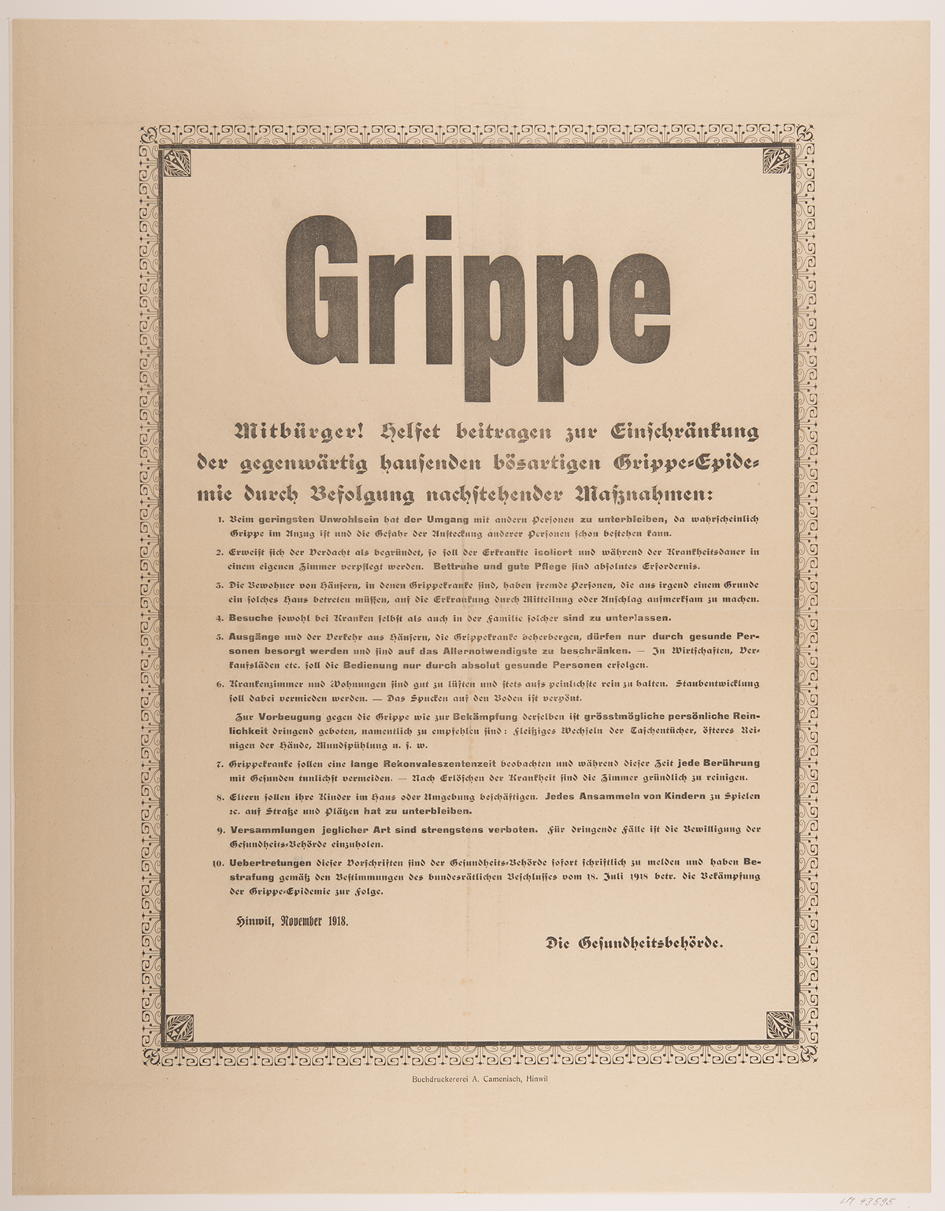
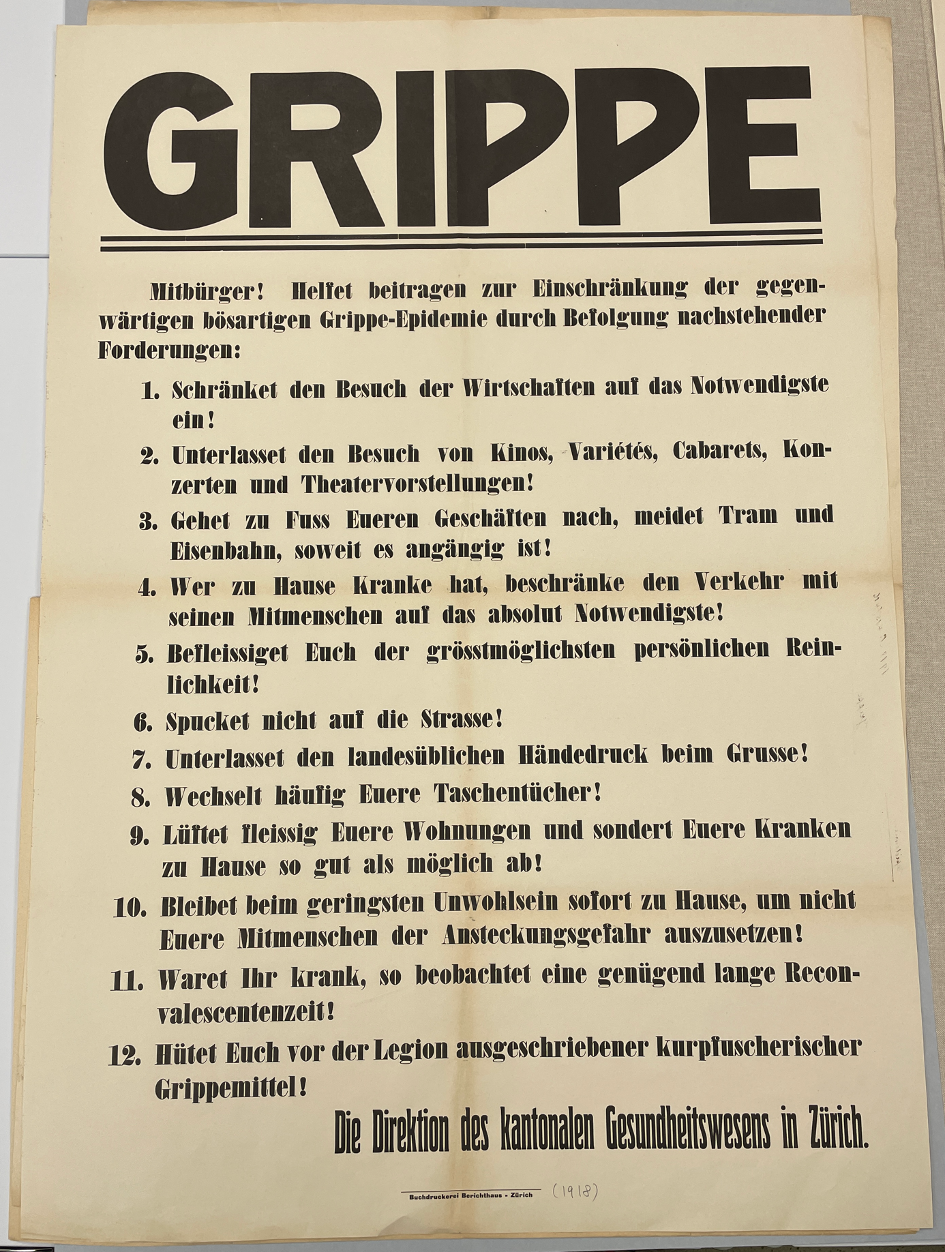
The city physician’s appeal was not heeded, and his fears proved justified. On 8 October, he wrote another article in the Neue Zürcher Nachrichten, denouncing the carelessness and indifference of broad sections of the population in the face of rising case numbers and reiterating his appeal for people to exercise personal responsibility. Nevertheless, the second wave of the pandemic followed, hitting both Switzerland as a whole and the canton of Zurich much harder than the summer wave. Pharmacies were forced to extend their opening hours, and there was a shortage of nursing staff. Emergency hospitals were set up. Pictures from the time show that even the Tonhalle was temporarily converted into an emergency hospital (see photo gallery). In mid-October, around 75,000 new cases were registered in the canton of Zurich – in a single week. In the city of Zurich alone, around 140 people died from the «Spanish flu» at the same time. As a result, the cantonal government reinstated the measures imposed in the summer, while municipalities put up posters to encourage residents to adopt certain behaviours in order to limit the spread of the pandemic (see photo gallery).
The second wave came at a turbulent time. Although the First World War was coming to an end, the situation in Switzerland was still tense. Housing prices were rising, and inflation was so high that a wage that had been enough for a working-class family to live on before the war was now barely enough to secure a minimum level of subsistence. Professional groups went on strike, violating the ban on assembly that was in place.
With the frequency of strikes mounting, a general strike was called at the beginning of November 1918. Tens of thousands of workers heeded the call of the strike leaders and gathered in Zurich, where they were confronted by 8,000 Swiss soldiers. With thousands of people coming together in the middle of a pandemic, the number of infections skyrocketed, especially among the soldiers, who were housed in cramped quarters in municipal facilities and buildings.
Who was to blame for the sick soldiers? The strike leaders, who had called the general strike, or the government, which had mobilised the military in response? This question was intensely debated by the Zurich cantonal council in December 1918, as the minutes of the meeting show. «The anarcho-socialist group and the wholehearted admirers of Bolshevism have made it necessary to continue the occupation of Zurich», declared the liberal-minded government president of Zurich, Gustav Keller. For cantonal councillor Ernst Reithaar of the SP, on the other hand, it was clear: «The blame for the further spread of the epidemic lies not merely in the deployment of troops, but also in the unworthy treatment of the soldiers.»
The number of cases rose further during the general strike and in its immediate aftermath, before gradually levelling off. Instead of one in fifty inhabitants of the canton of Zurich falling ill with «Spanish flu», it was now only around one in 200. As the situation slowly eased, the government council decided to lift the ban on public gatherings on 14 December, as the situation resulting from the general strike was «effectively almost equivalent to a lifting of the ban». Only meetings of choral societies and dance parties remained banned.
Throughout, the cantons were responsible for the measures to fight the novel epidemic. Although they often passed on this responsibility to the municipalities, it was still up to the cantons to establish the framework conditions. The fact that the Federal Council did not take on more responsibility bothered politicians in Zurich. At the beginning of December, the cantonal government therefore approached the Federal Council to enquire about the interpretation of legal articles. Specifically, the cantonal government wanted to know whether a decision by the Federal Council on the epidemic would apply retroactively and whether federal support payments would be directed only at those who had become «completely breadless» or at all those who had suffered major income losses as a result of the epidemic. Two weeks later, the Zurich Health Directorate, which was still waiting for an answer from Bern, urged the Federal Council to «send a response as soon as possible».
The Zurich government council had already let it be known on an earlier occasion that it did not fully agree with the national executive. The city of Zurich had paid 23,000 francs in compensation to musicians who had become unemployed. In doing so, it had relied on the law on dangerous epidemics, which provided for compensation for those who had become unemployed. The cantonal government then asked the Swiss Federal Office of Public Health whether and how the federal government would get involved, only to receive the answer: «Not at all». By law, only smallpox, Asian cholera, typhus and the plague were considered epidemics that pose a danger to the public, which is why it was not possible at the time to contribute to expenses incurred due to the «Spanish flu».
The government council then wrote to the public health department again, arguing that although the «Spanish flu» was not literally mentioned in the law, its purpose was «zno doubt that wherever diseases take on the character of epidemics dangerous to the public, the measures mentioned in the law should be applied accordingly»”. The federal government ought therefore reconsider its decision. It is not known whether and how the health authorities responded.
A few months later, the public health department held out the prospect of funding and asked the cantons to submit applications. In response, the cantonal government listed the costs that were to be covered by the federal government, requesting almost CHF 200,000 from the federal government (equivalent to around CHF 3 million in 2009). A large proportion of this – just under CHF 120,000 – was claimed by Zurich Cantonal Hospital. Individual municipalities also came forward, in some cases asking for smaller contributions. Mettmenstetten, a village in Zurich’s Säuliamt, for example, is included in the list at CHF 155. Höngg, now a district of Zurich, is listed at CHF 191. The government council explained that the list was not yet final. As a consequence of the flu, the city of Zurich alone had incurred costs similar to those of the cantonal hospital, and maintained that the federal government ought to contribute to these costs.
New cases of flu (influenza-like illnesses) reported by doctors are shown for the city and canton of Zurich, new deaths (all causes) for the city of Zurich and new hospitalisations due to influenza for the canton of Zurich by reporting week for 1917–1920. A reporting requirement for new cases of influenza was introduced by cantonal medical authorities for the first time on 24 July 1918 (and only in autumn 1918 at the national level).
The data source is the weekly bulletin of the Swiss Health Office 1917-1920. The new cases reported by doctors tend to be underestimates and may have been affected by a reporting backlog, especially in October and November 1918, but they nevertheless enable us to estimate the course of the pandemic. Missing individual weekly reports, especially before 1918, have been interpolated.
In spring 1919, the number of cases fell. In February, there were around 3,300 cases, in March around 2,600 and in April only around 720. The «Spanish flu» seemed as good as over. In July 1919, the cantonal government of Zurich proclaimed that the epidemic was almost over. In its communiqué, the government council took a retrospective look the «Spanish flu», which had «required a great deal of medical and official work».
This time, too, the use of the past tense was only partially justified. Cases of influenza continued to flare up and, in February 1920, were once again «so severe as to cause a stir». The Federal Council once again authorised the cantons to take decisions about measures and recommended, first and foremost, a ban on dancing and singing in large crowds. The canton of Zurich did not, however, put comprehensive measures in place.
Citation: Hedinger, Gian (2023). Die Spanische Grippe in Zürich 1918 - 1920. Interaktive Daten-Geschichte auf der LEAD-Webseite. URL: www.leaddata.ch
Contact: kaspar.staub@iem.uzh.ch
Literature: • Thalmann, Hans (1968). Die Grippeepidemie 1918/19 in Zürich. Juris, Zürich. • Ziegler, Ella (et al.) (2025).Retrospective modelling of the disease and mortality burden of the 1918–1920 influenza pandemic in Zurich, Switzerland. Epidemics, 50:100813.