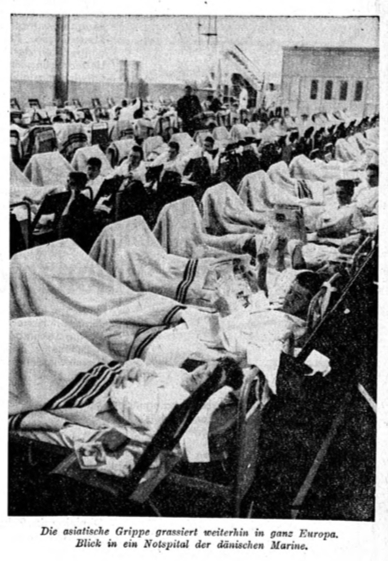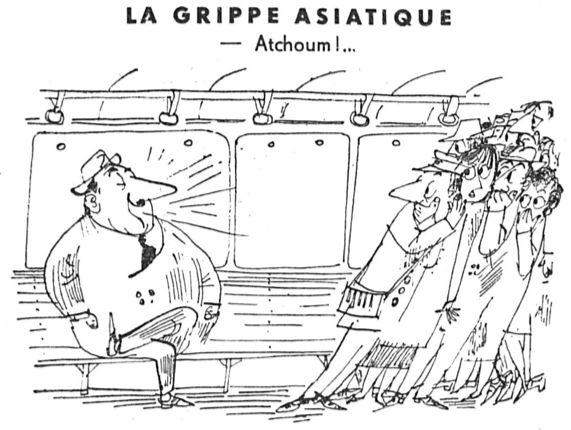
Caricature about the pandemic in the weekly newspaper Construire: hebdomadaire du capital à but social, 18 October 1957. Source: e-newspaper-archives
The influenza pandemic of 1957–1958 was the first pandemic of the virology era, that is after the influenza virus was identified as the pathogen and the WHO was established. The H2N2 virus was first detected in China in mid-February 1957. As the number of air travellers was still relatively low in 1957, it took several months for the virus to spread around the world. The pandemic was characterised by a high disease burden, but a comparatively low mortality rate. Nevertheless, around 1–4 million people worldwide died as a result of it.
Switzerland,1957: At the end of July, a few suspected cases of the flu in Schaffhausen are reported to the Federal Health Office in Bern – nothing to worry about. The Federal Office of Public Health documents the reported cases, 96 in total, and announces:
«Clinically, Asian flu does not differ from the previously known forms of flu with a mild course. […] The illness [begins] usually and especially in children with a feeling of thirst, which is followed after six to twelve hours by a severe sore throat. Objectively, there is severe reddening of the back wall of the throat and fever up to 39°, pulse around 120, subsequently generalised headache and, in adults and adolescents, often chest and back pain. A dry cough is common at this stage. The duration of the illness is usually four days, so that most patients are able to return to work after about five days. Severe complications in the form of secondary bronchitis, tonsillitis, etc., are rare.»
Reports from the World Health Organisation (WHO) warning of flu from Asia are initially dismissed by the Swiss authorities. According to Swiss newspapers, Switzerland remains unaffected. The Solothurner Zeitung writes on 11 September: «The Asian flu virus has not yet been detected anywhere in Switzerland. The number and course of the diseases are no cause for concern.» However, it soon becomes clear that the epidemiological situation has been underestimated. By the end of September, thousands of people in Switzerland have fallen ill with «Asian flu».
At the beginning of the pandemic, the country was gripped by uncertainty and insecurity. The Swiss population sought out answers in media coverage, but the media also had little information. At the same time, the most important authorities failed to communicate about the crisis. In an article on 27 September, the Zürcher Woche accused the Federal Office of Public Health of concealing the first signs of «Asian flu» in the country. This accusation was based on findings from 6 September about the first cases of flu at schools in Bern, which were ignored. The disease then spread rapidly. The Zürcher Woche wrote:
«This is precisely why it is certainly wrong to keep the occurrence of this flu a secret for as long as possible. There is no need to fear it any more than any other flu, but because of its strong symptoms, the public should know that they may have to deal with it.»
The Federal Office of Public Health, in turn, accused the newspapers of misinterpreting the course of the flu and publishing the findings in a distorted and hasty manner. «It is not possible to prevent the introduction of influenza into a country» – with this statement, the Federal Office of Public Health had warned against «Asian flu» at an early stage. Moreover, the Federal Influenza Centre had announced as early as 31 August that it wanted to identify the virus as quickly as possible, which it did following the usual testing procedure. The first positive result, and therefore the first confirmed case in Switzerland, was available on 9 September and was published immediately afterwards in the weekly bulletin Grippecommuniqué. The Hygienic-Bacteriological Institute of the University of Bern informed the Federal Office of Public Health on the same day: «The pathogen was first isolated in Singapore in May 1957. It [the Asian flu] is a type of influenza virus, type A, that has never been identified before.» Presumably, students returning from international holiday camps in England in August had introduced the virus to Switzerland.
Verena Lilljeqvist remembers the outbreak of the «Asian flu» in 1957.

Ulrich Castelberg recalls the «Asian flu» in Biel in 1957/58.

Christine Werner remembers the «Asian flu» in Toggenburg in 1957.
Just three weeks later, on 3 October, the National Council held a question-and-answer session on «Asian flu» in view of the rising number of cases. Federal Councillor Philipp Etter voiced the following opinion:
«At the beginning of September, the [...] virus was detected in Switzerland for the first time. It [the flu] is undoubtedly on the increase. It is generally mild. That is why only a few people who fall ill seek medical help. But thousands of people in our country are probably suffering from it at the moment. The disease occurs mainly in schools, military units and businesses, where there are large gatherings of people.»
Consequently, the Federal Council recognised the critical epidemiological situation in the country. From October to the end of December 1957, a strict reporting system was put in place for all reported cases of influenza (new cases of influenza had been subject to mandatory reporting in Switzerland since 1918). Every week, the Federal Office of Public Health sent a letter to the WHO’s Department of Communicable Diseases in Geneva. The letter reported on the number of cases, school absences and closures, and the number of flu-related deaths in municipalities with more than 10,000 inhabitants.
The Federal Council warned that, as with every flu epidemic, a certain number of deaths were to be expected, especially among older people. Young children and older people were to keep away from crowds. The sick were to be isolated immediately and not be allowed to remain in workplaces and schools. Above all, it was important to prevent the flu from spreading explosively in businesses and schools. In October 1957, the number of cases rose particularly sharply. At first, only affected school classes were closed in some cities, but then some cities closed their schools completely, started the autumn holidays earlier or extended them. Because a large proportion of the population was infected and/or fell ill, hospitals were closed to visitors. Moreover, due to the large number of cases, businesses and public services, such as the post office, telephone and public enterprises, were also severely disrupted and in some cases could only offer reduced service. Retired and unskilled labourers were called in to make up for missing staff. The daily newspapers also reported considerable disruptions to the football championships and cycling races due to the large number of sick athletes, while trade fairs, such as the Olma, attracted fewer visitors than expected.
Early on in the pandemic, the authorities constantly emphasised that a vaccine was the only effective measure against the virus. The production of vaccines was significantly accelerated in the USA, but given the late arrival of the vaccine in Europe, generally limited availability and its reduced effectiveness, it probably had little impact on the course of the pandemic, at least in Switzerland.
When asked about the distribution of a vaccine, the Federal Council replied: «Public mass vaccination is out of the question for us.» In the USA, production of a vaccine began immediately after the virus was identified, but even the country’s own requirements could not be met. It was expected that the USA would continue to ban the export of the vaccine. This meant that the hoped-for foreign support failed to materialise. Even if vaccine from Swiss or foreign production was available, it would be reserved for people whose services were indispensable during a pandemic, such as doctors, nurses and hospital staff. However, it was also cautioned that, according to earlier studies, the vaccination did not provide absolute protection (IMG_9041) and that it was not yet possible to make any statements about the duration of vaccination protection at the time.
Nevertheless, on 29 October 1957, the Federal Office of Public Health sent a letter to the Second Secretary of Embassy, USA, with information on the current situation of the influenza pandemic. It transparently communicated that 79,000 cases requiring medical treatment had been reported by 19 October. There was still a need for vaccine and a delivery was requested in the next two weeks. It later emerged that the vaccine was rather weak, with a protective effect of 70–80 percent at first and then 40–50 percent.
The H2N2 influenza virus was very easily transmitted and the pandemic swept like a wave across the whole country, as well as Europe. People became infected at breakneck speed, especially in schools, military facilities and large factories. The morbidity rate was relatively high, as a large proportion of the population was probably infected with the virus. At mass gatherings, such as recruit schools, the average disease rate was as high as 65 percent. In contrast, the death rate (mortality) remained comparatively low in Switzerland. For every 1,000 officially reported cases, around one person died as a result of «Asian flu», mostly due to complications following pneumonia. In 1957, a total of around 400 deaths were reported in connection with «Asian flu» between the end of September and the end of December. However, these morbidity and mortality figures require more detailed investigation before reliable conclusions can be drawn.
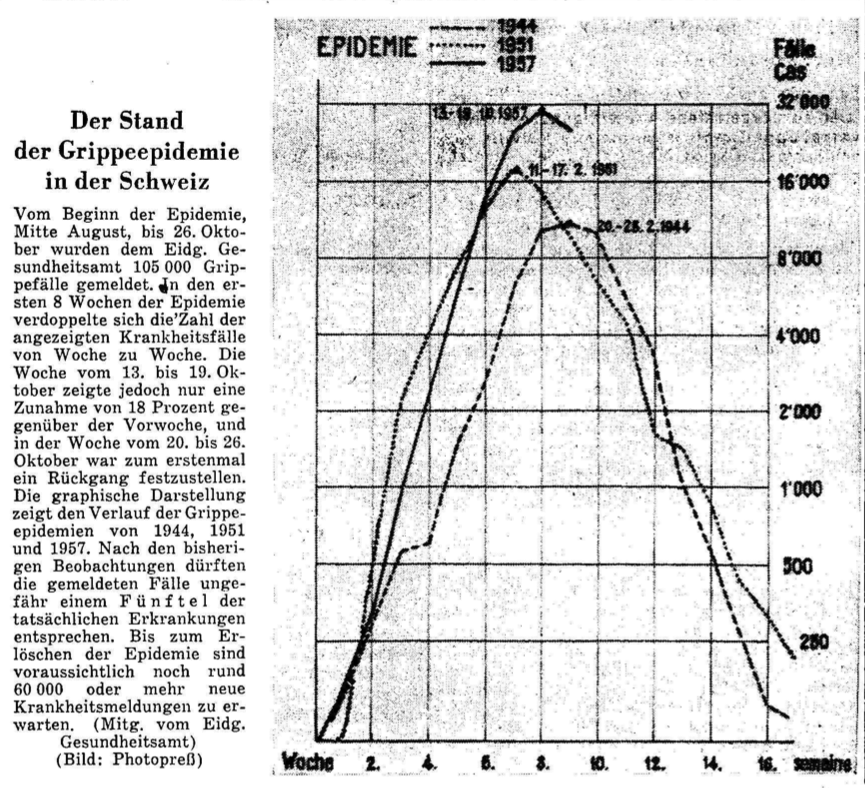
The reason for the rapid spread of «Asian flu» was that the population was not immune to the previously unknown pathogen. The virus strain (H2N2) was a new combination of the «Spanish flu» pathogen (H1N1 virus) with an H2N2 virus from birds. Prior to the outbreak of «Asian flu», the population had not formed any antibodies against the mixture of these virus lines. Following the outbreak, the number of reported cases doubled every week. Overall, there was a major pandemic wave that peaked in mid to late October 1957 with 30,096 reported cases. A total of 105,000 cases of influenza were reported from mid-August to 26 October. After that, a decrease in the number of infections compared to the previous week was observed for the first time.
However, the hope for a quick end failed to materialise. After just three weeks, the decline in reported flu cases slowed again. New mass gatherings and poor weather conditions probably led to new infections. The Federal Office assumed that a further 60,000 reports of illness would follow before the pandemic could be said to have subsided, which turned out to be accurate. The pandemic continued to rage, with the numbers reported each week decreasing only slowly. Finally, in the last week of December, a mere 2,107 cases were reported, and the pandemic wave slowly subsided.
However, the number of unreported cases was high. According to reports from the Federal Office of Public Health, the actual number of flu cases was probably four to five times higher, as only cases reported by doctors were recorded. In addition, the reporting obligation was not consistently adhered to everywhere due to the existence of mild cases. People who experienced a mild course did not always consult a doctor, and when entire families fell ill, often only one family member was recorded. A total of around 200,000 cases of flu were reported between 24 August and 28 December. In addition, there were also cases of influenza that occurred during military service, which were documented separately.
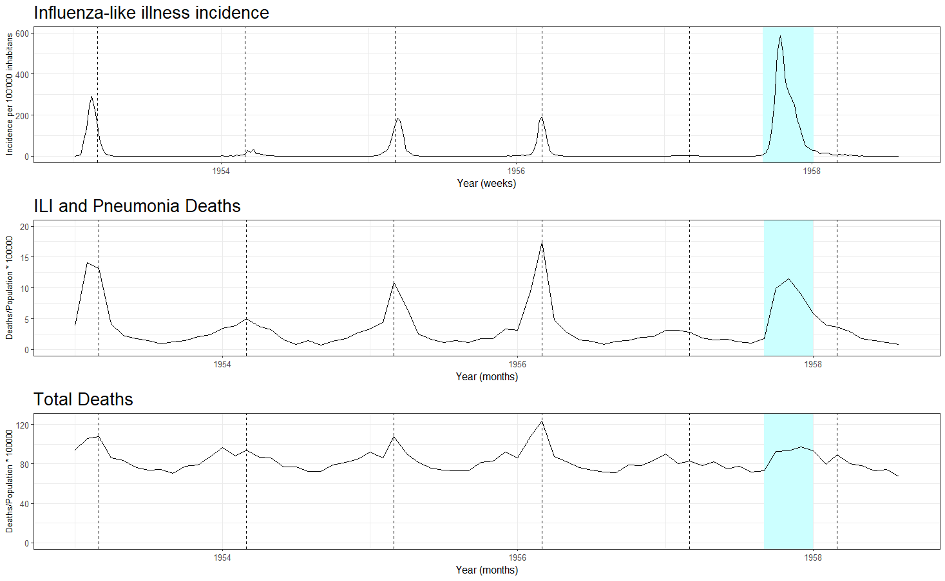
Description of «Asian influenza» from 1957–1958 in the context of previous years since 1953 in Switzerland with ILI-incidence (by week), ILI/pneumonia deaths and total deaths (both by month) (ILI = influenza-like illness). The dashed lines indicate the usual influenza season in February each year, while the coloured bar indicates the pandemic period in autumn/winter 1957–1958. Data source: Weekly bulletins of the Federal Office of Public Health.
Much of what we know today about «Asian flu» is based on the detailed reporting system of the Swiss military service. When the first eight cases of influenza occurred in the army on 14 September 1957, the military doctors documented the course of the pandemic in detail. Official reports, medical diaries and letters recorded the number of sick people, the measures taken and the deployment of medical personnel. In addition, the military introduced strict measures to limit the spread of the pandemic and prevent the civilian population from being infected. Due to negligent reporting, a «Circular on Influenza» was issued to all troop doctors and commanders on 1 October 1957, containing a guide to the medical service measures, as well as instructions on the reporting system for the sick population.
The most effective measures ordered were the suspension of almost all unit courses and unit deployments, physical rest for the men, segregation of the sick and evacuation to the barracks. Precautions were taken, such as extending sleeping hours, avoiding draughts in the troops’ quarters, turning on the heating and providing the troops with vitamin-rich food and hot tea. Regular gargling was the order of the day to disinfect their throats. Military operations were to continue insofar as possible, and sport was to be practiced on a moderate scale.
A recent review of the course of reported new cases and deaths (see figure) reflects the assessment that the pandemic in autumn 1957 was characterised by a very high number of illnesses compared to previous years, but that deaths, both as a whole and due to influenza/flu and pneumonia, scarcely differed from previous years. It is also clear that there was no seasonal flu epidemic in the winter of 1956/57. The extent to which this is related to the emergence of the pandemic the following fall is still in need of clarification.
Note: This report is largely based on a collection of sources in the Swiss Federal Archives.
Citation: Wyss, Valery (2023). The «Asian flu» 1957–1958. Data history on the LEAD website. URL: www.leaddata.ch
Contact: kaspar.staub@iem.uzh.ch
Literature: • Paccaud, Fred & Poncioni, Bernardo (1959). La pandémie grippale de 1957 et les autres maladies respiratoires à virus dans le canton de Genève (Suisse). Bulletin of the World Health Organization vol. 20,2-3: 498-504. • Vuilleumier, Christophe & Kaiser, Laurent (2020). Les pandémies à travers les âges: le cas suisse. Gollion: Infolio, 2020.